



Online
Date
30 March 2026
Time
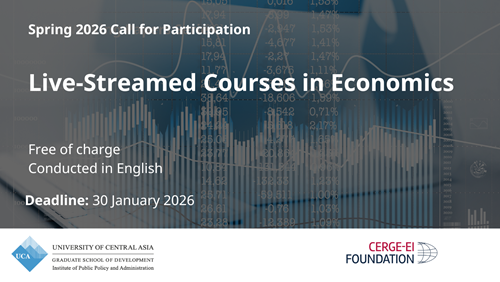
The University of Central Asia's (UCA) Institute of Public Policy and Administration (IPPA), in cooperation with the Center for Economic Research and Graduate Education's Economics Institute (CERGE-EI) Foundation, invites all master level students, faculty members, applied researchers, and other interested individuals to participate in a live-streamed economics course starting in March 2026. Courses will be delivered online from CERGE-EI’s Digital Media Center in Prague and coordinated by UCA to allow live streaming to multiple locations. Teaching Assistants from Kyrgyzstan and Kazakhstan will provide basic assistance with course delivery.
Costs and Tuition Fees
Courses are offered free of charge to course participants from Central Asian countries.
Language
The language of instruction for all courses is English
Course Schedule
In Spring 2026, courses will be offered on Applied Microeconomics, Climate Change Economics, Health Economics, Behavioral Economics, Econometrics in a Nutshell, Innovation Economics, and Modelling Macroeconomics. All courses will be conducted in six-week modules, with the final exam scheduled for Week seven and the make-up exam scheduled for Week eight. Participants who successfully complete courses will be awarded CERGE-EI Foundation certificates.
Admission Requirements
The program is intensive and rigorous, advanced BA/introductory MA level of Economics knowledge is required. Participants should expect to be challenged and should be able to demonstrate self-motivation. UCA reserves the right to select only those applicants that it believes to have the necessary qualifications and experience to succeed. All courses will require the active participation of all students. Teachers will utilise modern technology to engage students, encourage their active involvement in the course work and class discussions.
Registration
The number of places is limited. To register for a course, please fill in the registration form until March 30, 2026 6 pm Bishkek time, following the link below: https://forms.office.com/r/AMQFz8PMi0
Courses:
Part 2: Behavioral Economics, Econometrics in a Nutshell, Innovation Economics, Modelling Macroeconomics: How Macroeconomists Understand and Predict the World
Classes: April 27 – June 5, 2026
Final exam week: June 8 – 12, 2026
- Make-up exam week: June 15 – 19, 2026
Behavioral Economics
Brief description: The course aims to provide students with basic knowledge in the main areas of behavioral economics by focusing on the behavioral implications of theoretical models and experimental evidence in economics. The list of topics includes bounded rationality, decision-making under risk and uncertainty, preferences, intertemporal decision-making, attention and information acquisition, and other behavioral heuristics and biases. Upon successfully completing this course, students should be able to understand the conceptual framework of behavioral economics and its tools,
recognize behavioral biases and apply insights from psychology when predicting or analyzing economic decision-making.
Prerequisites: Microeconomics, Probability theory and Statistics at an introductory level.
Main Instructor: Aizhamal Rakhmetova, PhD candidate
Aizhamal Rakhmetova is a PhD candidate at CERGE-EI. She holds an MA in economics from CERGE-EI and Ural Federal University. Her research interests are mainly in the field of environmental economics, with her current research focused on the impact of climate shocks on the livelihoods of people in developing countries. Aizhamal was a visiting scholar at SIPA, Columbia University in the spring semester of 2022, where she developed her research project studying the effect of droughts on bride kidnapping in Kyrgyzstan. She enjoys teaching, and starting in 2015 was a TA and instructor of courses, including microeconomics, development economics, behavioral and experimental economics, and econometrics.
Teaching assistant: Madina Junussova, Ph.D.
Madina Junussova is a Senior Research Fellow at UCA's Institute of Public Policy and Administration. Dr. Junussova holds a PhD in Public Policy from Carleton University and degrees in architecture, urban and regional planning awarded by the Ministry of Education and Sciences of the Republic of Kazakhstan. With over 20 years of experience in urban and regional policy research, she has contributed to the OECD Urban Policy Review: Kazakhstan and served as an Expert Member of UNICEF’s External Reference Group on Children’s Rights and Urban Planning. Dr Junussova is a member of the UNECE Group of Experts on Coal Mine Methane and Just Transition and served as General Co-Rapporteur of the 59th ISOCARP World Planning Congress and the 5th Urban Economy Forum in 2023. She is currently the Principal Investigator of the Naryn Urban Resilience Programme and Resilient University Town Development initiative. Her work focuses on sustainable urban transformation, just transition, and evidence-based policymaking in Central Asia.
Dates: Classes: April 27 – June 5, 2026; Final exam week: June 8 – 12, 2026; Make-up exam week: June 15 – 19, 2026.
Econometrics in a Nutshell
Brief description: The course will introduce regression analysis and cover some of the most recent econometric techniques central to modern econometric practice. Successful students will gain a deeper understanding of the material discussed in other Distance Learning Program courses. They will be up to speed with Western European students at the same education level, making them more competitive in their further studies and on the labor market. At the end of this course students will understand basic econometric concepts, basic estimation methods, and methods for testing statistical hypotheses. They will be able to apply standard methods of constructing econometric models, process statistical information, obtain statistically sound conclusions, and give meaningful interpretation to the results of the estimated econometric models. In addition, students will gain real data processing skills, using econometric packages for building and estimating econometric models in R.
Prerequisites: Introduction to Statistics.
Main instructor: Ella Sargsyan, Ph.D.
Ella Sargsyan earned her Ph.D. degree in Economics and Econometrics from CERGE-EI in July 2024. After obtaining her degree, she worked as a Postdoctoral Researcher at Université catholique de Louvain. Currently, Ella is employed at ČSOB in the Credit Risk Modelling Department. Since 2016, Ella has been actively involved in teaching -- both as a graduate teaching assistant and as an instructor for courses such as Statistics, Econometrics, Development Economics, and Microeconomics. She also collaborated with the pedagogical team of CERGE-EI’s Academic Skills Center and serves as an instructor for the CERGE-EI Foundation pedagogical training for local instructors. Ella has applied a wide range of econometric techniques throughout her research career, working on topics such as the long-term effects of conflict exposure and environmental shocks on economic, social, and political outcomes in developing countries. She particularly enjoys working with spatial data and addressing policy-relevant questions using rigorous empirical methods.
Teaching assistant: Mariia Ianova (Iamshchikova)
Mariia Ianova is a Research Associate at the Institute of Public Policy and Administration of the University of Central Asia. She holds a BA in Economics from the American University of Central Asia. Her research expertise includes but not limited to health economics, gender, socio-economic development, food security and nutrition, and development economics.
Dates: Classes: April 27 – June 5, 2026; Final exam week: June 8 – 12, 2026; Make-up exam week: June 15 – 19, 2026.
Innovation Economics
Brief description: Technology advances rapidly and affects us all, as new products and production methods continually replace old ones. Technological progress is a key driver of long-term economic growth, constantly improving living standards, health, and quality of life worldwide. But do we fully understand the mechanisms behind these processes? Why do firms innovate and race to be first in research and development? Can free markets efficiently handle the creation and diffusion of new ideas and technologies? How can creativity, knowledge production, and risky exploration be incentivized? Does knowledge travel freely across borders, and why do innovation clusters emerge? These and many other questions surrounding innovation are highly debated and often lead to controversial conclusions. A scientific approach is therefore essential to provide the theoretical foundations needed to understand the economics of innovation. The awarding of the 2025 Nobel Prize in Economics for research in innovation economics underscores the societal importance of uncovering how innovation works, recognizing its costs and benefits, and fostering openness to new ideas and change. This course combines solid theoretical foundations from leading economic research with real-world cases and anecdotes that stimulate discussion and learning.
Prerequisites: Microeconomics at the intermediate level.
Main instructor: Taras Hrendash, Ph.D.
Taras Hrendash is a Data Analyst at the Research and Development Council of the Czech Republic and a Senior Researcher specializing in the economics of science, technological change, and innovation at the IDEA Think Tank at CERGE-EI and the Economic Institute of the Czech Academy of Sciences. He holds a PhD from CERGE-EI, and his research focuses on the geography of innovation, commercialization of patents, scientometrics, and the demography of the scientific population. Since Fall 2020, Taras has worked closely with the CERGE-EI Foundation Distance Learning Program as a Main Instructor and Learning Technology Coordinator.
Teaching assistant: Kuandyk Tleuzhanuly
Kuandyk Tleuzhanuly holds a master’s degree in public administration from KIMEP University. He is a PhD candidate in Public Administration at Narxoz University, his research interests include educational inequality, impact of socioeconomic status on academic achievement, and public policy in education.
Dates: Classes: April 27 – June 5, 2026; Final exam week: June 8 – 12, 2026; Make-up exam week: June 15 – 19, 2026.
Modelling Macroeconomics: How Macroeconomists Understand and Predict the World
Brief description: The aim of the course is to acquaint students with the general ideas behind structural macroeconomic modelling and how it can be applied to better understand real-world data, whether GDP fluctuations, evolution of lifetime income, or the decision of household to spend monetary transfers on consumption. We will cover several classical and widely used macro models focusing on economic growth, the development of income and consumption inequality over the lifetime of individuals, and on the differences in behavior of poor vs. wealthy households. For each model, we will acquire basic intuition on how a model works and then describe how a model is calibrated to real data. The study of each model will conclude with a discussion on how the model helps us to understand the real world and what it fails to explain.
Prerequisites: The main prerequisites are critical thinking, a readiness to discuss and challenge model assumptions and predictions, and introductory level macroeconomics and microeconomics. Some very basic knowledge of calculus (e.g., first order derivatives) is welcome.
Main instructor: Daniil Kashkarov, Ph.D.
Daniil Kashkarov is a Postdoctoral Researcher at Universidad Carlos III de Madrid. He obtained his Ph.D. in 2024 from CERGE-EI, Prague. His interests lie in macroeconomics and labor economics, with a focus on life-cycle modeling, skills accumulation, and the adaptation of workers to labor market disruptions. In his current research, Daniil integrates adaptation theory from Biology, Ecology, and Economics to analyze and predict workers' adaptation to automation, AI introduction, and climate change. He has spent three semesters at Yale University during his 4th and 5th years of Ph.D. studies.
Teaching assistant: Kuandyk Tleuzhanuly
Kuandyk Tleuzhanuly holds a master’s degree in public administration from KIMEP University. He is a PhD candidate in Public Administration at Narxoz University, his research interests include educational inequality, impact of socioeconomic status on academic achievement, and public policy in education.
Dates: Classes: April 27 – June 5, 2026; Final exam week: June 8 – 12, 2026; Make-up exam week: June 15 – 19, 2026.
About the University of Central Asia (UCA) and UCA's IPPA
The University of Central Asia (UCA) was founded in 2000 as a private, not for profit, secular university through an International Treaty signed by the Presidents of Kyrgyzstan, Tajikistan, and Kazakhstan, and His Highness the Aga Khan; ratified by their respective parliaments and registered with the United Nations. As a university focused on the development of mountain societies, UCA's undergraduate programmes are located at its purpose-built world class residential campuses in Naryn, Kyrgyzstan, and Khorog, Tajikistan near the Tien Shan and Pamir mountains respectively. Established in 2011, UCA's Institute of Public Policy and Administration (IPPA) strengthens public policy making in Central Asia. It provides in-depth analysis of current and emerging policy issues facing the region and works on improving the analytical capacity of governments and civil society to use evidence-based decision-making through professional development. IPPA is part of University of Central Asia’s Graduate School of Development.
About CERGE-EI and the CERGE-EI Foundation
The Center for Economic Research and Graduate Education (CERGE) was established in 1991 in the Czech Republic to offer a western-style PhD in Economics to students from the countries of Central and Eastern Europe and the former Soviet Union. It subsequently formed a joint workplace with the Economics Institute (EI) of the Czech Academy of Sciences. Today, CERGE-EI offers two additional master level programs: one-year long Masters in Applied Economics and two-years long Masters in Economic Research. All faculty are western-trained and CERGE-EI graduates receive degrees that are recognised in the EU and in the US. The CERGE-EI Foundation is a major financial supporter of CERGE-EI and, through its Teaching Fellows Program, supports western-trained economists teaching at universities across the region.