


Online
Date
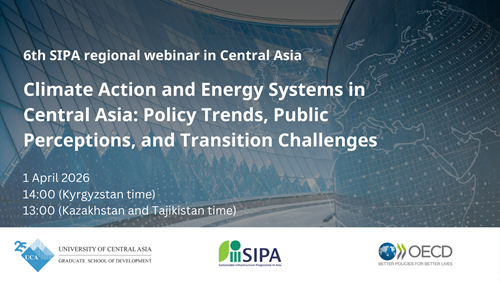
1 April 2026
Time
14:00 (Kyrgyzstan time), 13:00 (Kazakhstan and Tajikistan time)
Context and objectives
This sixth SIPA Regional Webinar will focus on the evolving landscape of climate action policies, public perceptions of energy transition, and the future of energy systems in Central Asia. As countries in the region work toward low-carbon development pathways, they face the challenge of balancing climate commitments with economic development, energy security, and public acceptance of transition policies.
The OECD will present findings from the Climate Actions and Policies Measurement Framework (CAPMF), a harmonised database tracking climate mitigation policies across countries. Drawing on the latest evidence for Central Asia and Mongolia, the presentation will highlight how climate action in the region has evolved over time, the key policy instruments supporting mitigation efforts, and how these trends compare with those in OECD countries. The discussion will also reflect on the implications for sustainable infrastructure development in Central Asia.
The webinar will also present findings from a nationwide survey on public perceptions of a just energy transition in Kazakhstan. The study explores how citizens understand climate change and transition policies, particularly in fossil-fuel-dependent communities. While awareness of climate change is relatively high, the findings reveal limited public understanding of transition policies and concerns related to job losses, limited economic alternatives, and insufficient local communication. At the same time, the survey highlights strong public support for renewable energy development and economic diversification.
Finally, the session will examine the future of Kyrgyzstan’s energy sector, focusing on the country’s reliance on hydropower, growing electricity demand, and structural supply shortages. The discussion will explore possible pathways for a green transition, including the expansion of renewable energy sources such as wind and solar, while also addressing policy debates around planned coal-based power generation and the broader challenge of balancing energy security with decarbonisation commitments.
Together, these perspectives aim to provide a comprehensive discussion on how Central Asian countries can navigate the complex trade-offs between climate action, sustainable infrastructure development, and long-term energy security.
Organisation details
Participants are invited to register at this link before 30 March 2026.
English and Russian interpretation will be provided.
Contact information
- Kanat Tilekeyev, Associate Director, IPPA, UCA kanat.tilekeyev@ucentralasia.org
- Peline Atamer, Senior Policy Analyst and Head of SIPA Central Asia, OECD peline.atamer@oecd.org
Agenda
|
Berlin, Paris (UTC+2; CEST)
|
Ashgabat, Astana, Dushanbe, Tashkent (UTC+5) |
Bishkek (UTC+6) |
Ulaanbaatar (UTC+8) |
|
|
10:00 - 10:10 |
13:00 – 13:10 |
14:00 - 14:10 |
16:00 – 16:10 |
Welcoming webinar participants Peline Atamer, Senior Policy Analyst and Head of Unit, OECD Dr Kanat Tilekeyev, Associate Director and Senior Research Fellow, UCA IPPA |
|
10:10 - 10:30 |
13:10 – 13:30 |
14:10 - 14:30 |
16:10 - 16:30 |
Measuring Climate Action in Central Asia and Mongolia Daniel Nachtigall, Economist, Environmental Performance and Information Division, OECD Environment Directorate Elena Rick Spearman, Data Analyst, Environmental Performance and Information Division, OECD Environment Directorate Join us for a presentation on the OECD’s Climate Actions and Policies Measurement Framework (CAPMF) and explore how climate mitigation policies in Central Asia and Mongolia have evolved, with insights for sustainable infrastructure development in the region. |
|
10:30 - 10:50 |
13:30 – 13:50 |
14:30 - 14:50 |
16:30 - 16:50 |
Measuring Climate Action Through People’s Eyes: Evidence from Kazakhstan’s Energy Transition Dr Madina Junussova, Senior Research Fellow, UCA IPPA / Urban Development Lead, UCA GSD / Interim Director, CSI A presentation of findings from a nationwide survey on public perceptions of a just energy transition in Kazakhstan. Join us to explore how climate change awareness, economic concerns, and support for renewable energy shape public attitudes toward transition policies. |
|
10:50 - 11:10 |
13:50 – 14:10 |
14:50 - 15:10 |
16:50 - 17:10 |
Kyrgyzstan’s Energy Sector Future Dr Kanat Tilekeyev, Associate Director and Senior Research Fellow, UCA IPPA Explore Kyrgyzstan’s energy sector at a turning point, including electricity shortages, reliance on hydropower, renewable energy pathways, and the implications of planned coal investments for energy security and climate commitments. |
|
11:10 – 11:25 |
14:10 – 14:25 |
15:10 – 15:25 |
17:10 – 17:25 |
Q&A |
|
11:25– 11:30 |
14:25 – 14:30 |
15:25– 15:30 |
17:25– 17:30 |
Closing remarks |
Background information
The Sustainable Infrastructure Programme in Asia
The webinar contributes to implementing the Sustainable Infrastructure Programme in Asia (SIPA) framework, led by Organisation for Economic Cooperation and Development (OECD) and funded by the German Government: www.sipa-centralasia.org. The SIPA aims to help Central and Southeast Asian countries ensure energy, transport and industrial infrastructure investments aligned with low-emission development pathways compatible with the Paris Agreement and the Sustainable Development Goals.
SIPA’s activities target all stages of infrastructure development, from planning and design to financing and delivery. Its activities mainly involve six countries in Asia including three countries in Central Asia (Kazakhstan, Mongolia and Uzbekistan) and three countries in Southeast Asia (Indonesia, the Philippines and Thailand). The Programme’s period of implementation is 2021 to 2025.
The OECD
The Organisation for Economic Co-operation and Development (OECD) is an international organisation that works to build better policies for better lives. Our goal is to shape policies that foster prosperity, equality, opportunity and well-being for all. We draw on 60 years of experience and insights to better prepare the world of tomorrow.
The OECD brings together its 38 Member countries and a range of partners that collaborate on key global issues at national, regional and local levels. Through our standards, programmes and initiatives, we help drive and anchor reform in more than 100 countries around the world, building on our collective wisdom and shared values.
More information on the OECD at https://www.oecd.org/.
The University of Central Asia
The University of Central Asia (UCA) is a secular, private, not-for-profit university founded in 2000 through an International Treaty signed by the Ismaili Imamat along with the Governments of Kazakhstan, Kyrgyzstan and Tajikistan, ratified by their respective parliaments and registered with the United Nations.
The mission of UCA is to promote the social and economic development of Central Asia, particularly its mountain communities, by offering an internationally recognized standard of higher education and enabling the peoples of the region to preserve their rich cultural heritage as assets for the future.
More information on the UCA at https://ucentralasia.org/