


Bishkek, Kyrgyz Republic
Date
31 March 2026
Time
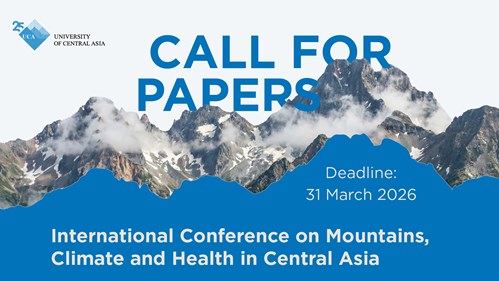
The University of Central Asia (UCA) invites submissions for the International Conference on Mountains, Climate and Health in Central Asia, to be held in Bishkek, Kyrgyzstan, on 18–19 June 2026.
The conference will bring together researchers, practitioners, policymakers, and development partners from Central Asia and internationally to advance evidence, share experience, and strengthen dialogue at the intersection of climate change and human physical and mental health. Particular emphasis will be placed on mountain regions, vulnerable populations, and resource-constrained settings, where climate impacts on health are most acute and least studied.
Objective
The conference is expected to generate policy-relevant insights, strengthened research and practice networks, and a small set of regionally grounded recommendations to inform future research, programming, and investment.
The Conference will also serve as an evidence-building and dialogue platform contributing to preparations for the Bishkek +25 Global Mountain Summit scheduled for October 2027, ensuring that health dimensions are fully integrated into global and regional mountain policy discussions.
Scope and Themes
Submissions are invited that engage with one or more of the following thematic areas:
Climate, Food Systems, and Health
- Climate impacts on food security, nutrition, and dietary diversity
- Agricultural change, livelihoods, and health outcomes
- Malnutrition, child health, and long-term human development under climate stress
Climate, Water Systems, and Health
- Glacier retreat, water scarcity, and seasonal variability
- Floods, droughts, and impacts on health infrastructure and services
- Water-borne and vector-related diseases
- Public health preparedness in urban, rural, and mountain contexts
Climate, Air Quality, and Health
- Heat exposure, air pollution, and respiratory or cardiovascular health
- Indoor air quality in cold, high-altitude, or energy-poor settings
- Health implications of energy, heating, and transport transition
Cross-cutting: Data, AI, and Decision-making for Climate–Health Resilience
- Climate–health data integration and early warning systems
- Applications of artificial intelligence and digital tools
- Ethical, governance, and equity considerations in climate–health innovation
- Translating data and evidence into policy and practice
Types of Contributions
- Research papers (empirical, methodological, or conceptual)
- Policy and practice case studies
- Programme and implementation reflections from practitioners and development organisations
- Poster presentations showcasing applied research, emerging findings, or practice-based insights
- Non-traditional research outputs that contribute to climate–health understanding and policy dialogue. These may include documentary film, visual or participatory research, data visualisation, or other innovative formats.
Submissions that offer comparative perspectives, link research to policy or implementation, or address pathways from science to decision-making are particularly encouraged. Early-career researchers and practitioners from Central Asia are particularly encouraged to apply.
Submission Guidelines
- Abstracts in English should be 300–500 words and clearly indicate the relevance to one or more conference themes.
- Submissions may be theoretical, empirical, or applied, but should demonstrate clear relevance to climate-related health challenges in mountainous regions.
- While the conference focuses on Central Asia, submissions drawing on international experience from comparable mountainous contexts are welcome.
Review and Selection
Submissions will be reviewed by the conference technical committee based on:
- relevance to the conference themes
- quality and originality
- contribution to evidence-based dialogue
- policy or practical significance
Conference Format
The conference will be predominantly in person, featuring keynote lectures, plenary sessions, thematic panels, and interactive discussions.
The languages of the conference are English and Russian. Simultaneous translation will be provided.
All costs associated with participation, including travel and accommodation, will be borne by participants unless otherwise specified.
Contact
For submission details and further information, please contact:
climate@ucentralasia.org