


Online
Date
20 August 2026
Time
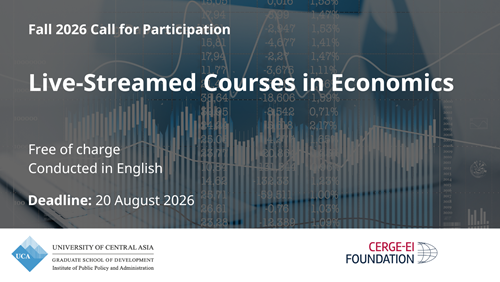
The University of Central Asia's (UCA) Institute of Public Policy and Administration (IPPA), in cooperation with the Center for Economic Research and Graduate Education's Economics Institute (CERGE-EI) Foundation, invites all master level students, faculty members, applied researchers, and other interested individuals to participate in a live-streamed economics course starting in March 2026. Courses will be delivered online from CERGE-EI’s Digital Media Center in Prague and coordinated by UCA from Kyrgyzstan and Kazakhstan to allow live streaming to multiple locations. Teaching Assistants from UCA will also provide basic assistance with course delivery.
Costs and Tuition Fees
Courses are offered free of charge to course participants.
Language
The language of instruction for all courses offered by the CERGE-EI Foundation is English. However, we allow for flexibility in using native language when delivering exercise sessions by local instructors.
Course Schedule
In Fall 2026, courses will be offered on Gender Economics, Economics of Energy, Introduction to Data Science, Econometrics in a Nutshell, Environmental Economics, Public Economics. All courses will be conducted in six-week modules, with the final exam scheduled for Week seven and the make-up exam scheduled for Week eight. Participants who successfully complete courses will be awarded CERGE-EI Foundation certificates.
Admission Requirements
The program is intensive and rigorous, advanced BA/introductory MA level of Economics knowledge is required. Participants should expect to be challenged and should be able to demonstrate self-motivation. UCA reserves the right to select only those applicants that it believes to have the necessary qualifications and experience to succeed. All courses will require the active participation of all students. Teachers will utilise modern technology to engage students, encourage their active involvement in the course work and class discussions.
Registration
The number of places is limited. To register for a course, please fill in the registration form until 20 August, 2026:
Courses:
Part 1: Gender Economics, Economics of Energy, Introduction to Data Science
- Classes: September 7 – October 16, 2026
- Final exam week: October 19 – 23, 2026
- Make-up exam week: October 26 – 30, 2026
Gender Economics
Brief description: The focus of the course is gender differences in the labour market and will cover both theoretical and empirical studies. Students will delve into these topics to understand how gender is relevant in the economy. Students will obtain an evidence-based understanding of two key aspects: 1) the potential mechanisms behind gender inequality and 2) the policies and evidence of their effects on advancing gender equality. Specifically, this course analyses the economic aspects of gender-related issues, such as gender wage gaps, labour force discrimination, family-friendly policies in the workplace, the valuation of unpaid household work, and the differential impact of public policies. During the course, students will become familiar with the methodology of gender analysis in the economic sciences and research gender analysis indicators to support skills development for relevant research and analysis.
Prerequisites: Introduction to Economics.
Main instructor: Ardiana Gashi, Ph.D.
Ardiana is a professor at the University of Pristina. She holds a PhD in economics from Staffordshire University (United Kingdom). Her research interests are in the fields of labour economics and gender economics. Her research focus is on labour markets, gender, migration, and education. Since 2007, Ardiana has taught labour economics, econometrics, statistics, and since 2021 has taught gender economics. Ardiana has consulted on the development of public policies related to labour and gender equality, and in the monitoring and evaluation of public policies and government interventions aimed to address gender imbalance.
Teaching assistant: Mariia Iamshchikova
Mariia Iamshchikova is a Research Associate at the Institute of Public Policy and Administration of the University of Central Asia. She holds a BA in Economics from the American University of Central Asia. Her research expertise includes but not limited to health economics, gender, socio-economic development, food security and nutrition, and development economics.
Dates: Classes: September 7 – October 16, 2026; Final exam week: October 19 – 23, 2026; Make-up exam week: October 26 – 30, 2026.
Economics of Energy
Brief description: Energy is a necessity of daily life and vital input to industry around the world. Energy also plays a central role in climate policy and geopolitics. The course, including the viewpoints of economic markets and economic regulation, aims to inform about various energy system topics. The focus will be on the supply side of the market, targeting the main properties of fossil and renewable energy sources. While economics (supply, demand, and pricing) is the focus, special attention is also given to the security and strategic value of the different energy sources. Part of the course gives a broad background of knowledge on energy topics and issues. The other part uses economic tools and mathematical models to better understand the economic logic of energy. Such economic tools provide a way to systemise the abundance of information available on energy. This also helps to understand and appraise present policies regarding energy. Though our scope is general, attention is paid to some of the local settings for the EU, the Caucasus, Ukraine, Central Asia, and Russia.
Prerequisites: Microeconomics: consumption, production, supply and demand, at least at the level of any of the following or equivalent books (any editions):
Besanko, D., & Braeutigam, R. (2020). Microeconomics. Wiley Global Education.
Krugman, P., Wells, R., Ray, M., & Anderson, D. A. (2013). Microeconomics in Modules. Macmillan Higher Education.
Perloff, J. M. (2018). Microeconomics, Global Edition. Pearson Education Canada.
Pindyck, R. S., Rubinfeld, D. L., & F. E., Microeconomics, (2001). by Prentice-Hall. Madrid. Varian, H. R. (2014). Intermediate microeconomics with calculus: a modern approach. WW Norton & Company.
Main instructor: Silvester van Koten, Ph.D.
Silvester is an economist specialising in Economics Experiments and Energy Economics with a special interest in the economics of regulation, market design and energy markets. He holds a Ph.D. in economics (from CERGE-EI) and an MA in Psychology (Utrecht University). Presently, Silvester is a senior researcher at the Department of Economics at the Jan Evangelista Purkyně University, and a research associate at CERGE-EI in Prague. Silvester’s current research appraises the effect of the structure of spot market prices on the forward premium in electricity markets and the effectiveness of self-regulating organisations using theory, simulations and economics experiments. In previous research, Silvester analysed the effects of more transparent financial markets on competition and prices in the EU electricity markets. His work was published in journals such as Energy Economics, Energy Policy, European Economic Review and the Journal of Regulatory Economics.
Teaching assistant: Madina Junussova, Ph.D.
Madina Junussova is an Urban Development Lead at the Graduate School of Development, a Senior Research Fellow at UCA's Institute of Public Policy and Administration and a CERGE-EI Foundation Teaching Fellow. Dr. Junussova holds a PhD in Public Policy from Carleton University and degrees in architecture, urban and regional planning awarded by the Ministry of Education and Sciences of the Republic of Kazakhstan.
Dates: Classes: September 7 – October 16, 2026; Final exam week: October 19 – 23, 2026; Make-up exam week: October 26 – 30, 2026.
Introduction to Data Science
Brief description: This course provides an introduction to data science as a profession and focuses on the theoretical methodologies of the most widely applied machine learning models. The main topics covered include: data preparation (data mining, cleaning and exploring strategies), statistical modeling with the application of appropriate machine learning methodologies (data segmentation, predictive analytics, recommendation systems), and mathematical evaluation.
Prerequisites: Statistics and Econometrics at intermediate level, experience with at least one programming language for statistical data analysis (Python, R, Stata or others).
Main instructor: Vahan Sargsyan, Ph.D.
Vahan is a full time Data Scientist working with big data and implementing machine learning technologies in a cloud-based computer software company. He received his Ph.D. from CERGE-EI in 2019 and also holds a Master degree in Economics from the International School of Economics at TSU, Georgia, and a Master degree in marketing from the Armenian State Agrarian University, Armenia. Vahan also held a 6-month traineeship at the European Research Council Executive Agency (ERCEA) in 2017-2018, where he was enrolled in data analytics and scientific evaluation of research applicants. During his Ph.D. studies, his research was focused on empirical economics, migration and labor economics, specialising in work discrimination.
Teaching assistant: Kuandyk Tleuzhanuly
Kuandyk Tleuzhanuly holds a master’s degree in public administration from KIMEP University. He is a PhD candidate in Public Administration at Narxoz University, his research interests include educational inequality, impact of socioeconomic status on academic achievement, and public policy in education.
Dates: Classes: September 7 – October 16, 2026; Final exam week: October 19 – 23, 2026; Make-up exam week: October 26 – 30, 2026.
Part 2: Econometrics in a Nutshell, Environmental Economics, Public Economics
- Classes: October 26 – December 4, 2026
- Final exam week: December 7 – 11, 2026
- Make-up exam week: December 14 – 18, 2026
Econometrics in a Nutshell
Brief description: The course will introduce regression analysis and cover some of the most recent econometric techniques central to modern econometric practice. Successful students will gain a deeper understanding of the material discussed in other Distance Learning Program courses. They will be up to speed with Western European students at the same education level, making them more competitive in their further studies and on the labor market. At the end of this course students will understand basic econometric concepts, basic estimation methods, and methods for testing statistical hypotheses. They will be able to apply standard methods of constructing econometric models, process statistical information, obtain statistically sound conclusions, and give meaningful interpretation to the results of the estimated econometric models. In addition, students will gain real data processing skills, using econometric packages for building and estimating econometric models in R.
Prerequisites: Introduction to Statistics.
Main instructor: Ella Sargsyan, Ph.D.
Ella Sargsyan earned her Ph.D. degree in Economics and Econometrics from CERGE-EI in July 2024. After obtaining her degree, she worked as a Postdoctoral Researcher at Université catholique de Louvain. Currently, Ella is employed at ČSOB in the Credit Risk Modelling Department. Since 2016, Ella has been actively involved in teaching -- both as a graduate teaching assistant and as an instructor for courses such as Statistics, Econometrics, Development Economics, and Microeconomics. She also collaborated with the pedagogical team of CERGE-EI’s Academic Skills Center and serves as an instructor for the CERGE-EI Foundation pedagogical training for local instructors. Ella has applied a wide range of econometric techniques throughout her research career, working on topics such as the long-term effects of conflict exposure and environmental shocks on economic, social, and political outcomes in developing countries. She particularly enjoys working with spatial data and addressing policy-relevant questions using rigorous empirical methods.
Teaching assistant: Saniya Soltybayeva
Saniya Soltybayeva is a Ph.D Candidate at Nazarbayev University, she holds a Master’s degree in Local Economic Development from the London School of Economics and Political Science and a Specialist degree in Public Administration from Lomonosov Moscow State University. Her research interests include regional and local economic development, decentralisation, human capital development, and regional innovation systems.
Dates: Classes: October 26 – December 4, 2026; Final exam week: December 7 – 11, 2026; Make-up exam week: December 14 – 18, 2026.
Environmental Economics
Brief description: This course introduces major concepts in the field of environmental economics. It is designed to help students understand theories related to natural resources and make use of microeconomic and statistical analysis. This course will also focus on valuation techniques for environmental goods used in the real world by analysts and policy makers. There is a growing demand in economics and public sectors for individuals with quantitative skills who can understand and apply these techniques, analyze results, and produce reports. By the end of this course, students will be able to analyze economic problems related to environmental goods using rigorous valuation techniques.
Prerequisites: Microeconomics and statistics/econometrics at the introductory level. Since this course includes empirical applications, it is expected that universities provide students the STATA software.
Main instructor: Vladimir Otrachshenko, Ph.D.
Vladimir is a research associate at the Center for International Development and Environmental Research (ZEU), Justus Liebig University Giessen, Germany. He holds a Ph.D. in economics from Nova School of Business and Economics, Lisbon, Portugal. His research interests are environmental and resource economics, health and population economics, development economics, climate change, non-market valuation of public goods, field experiments, and quality of life with a focus on Eastern Europe and Central Asia. He contributed to several Horizon projects and currently is involved in the SDGnexus project. He taught at Venice International University, Italy; and the University of Regensburg, Germany; at undergraduate, master, and Ph.D. levels. He has published in peer-reviewed journals, including Journal of Public Economics, Economic Inquiry, Journal of Comparative Economics, Environmental and Resource Economics, Ecological Economics, and Land Economics.
Teaching assistant: Zhandos Tursunbekov is a Ph.D. candidate at CERGE-EI. He holds a Master’s degree in Finance from Loughborough University and a Specialist degree in Aerospace Engineering from Bauman Moscow State Technical University. His research focuses on Development Economics, Applied Microeconomics, Climate Change, and Economic History.
Dates: Classes: October 26 – December 4, 2026; Final exam week: December 7 – 11, 2026; Make-up exam week: December 14 – 18, 2026.
Public Economics
Brief description: This course covers the key concepts in public economics, a field of economics that studies the role of government in the economy. The course is designed to introduce seminal theoretical concepts and discuss the most recent empirical developments in public economics with the aim to understand: (i) why and how governments intervene in an economy, (ii) how individuals and firms react to these interventions, and (iii) what are the implications of those interventions for the overall welfare and economic development.
Prerequisites: Microeconomics, macroeconomics, and econometrics at the introductory level.
Main instructor: Olga Popova, Ph.D.
Olga is a senior researcher with tenure at the Leibniz Institute for East and Southeast European Studies (IOS), Regensburg, Germany; a research associate at CERGE-EI; and a research fellow at IZA-Institute of Labor Economics and Global Labor Organization (GLO). She holds a Ph.D. in economics from CERGE-EI (2012). Her research interests include health and environmental economics, economic history, development economics, and public economics. She is an associate editor at the Journal of Population Economics, Journal of Happiness Studies, and Comparative Southeast European Studies, served as a consultant for the World Bank, and was Second Prize winner of the 2014 Young Economist Award from the Czech Economic Society. Her research has been published in the Journal of Public Economics, Economic Inquiry, Journal of Comparative Economics, and Small Business Economics, among others, and was featured by the leading research policy portal VoxEU.
Teaching assistant: Madina Junussova, Ph.D.
Madina Junussova is a Senior Research Fellow at UCA's Institute of Public Policy and Administration and a CERGE-EI Foundation Teaching Fellow. She is a member of the International Public Policy Association and the International Society of City and Regional Planners (Isocarp). Dr. Junussova holds a PhD in Public Policy from Carleton University and degrees in architecture, urban and regional planning awarded by the Ministry of Education and Sciences of the Republic of Kazakhstan.
Dates: Classes: October 26 – December 4, 2026; Final exam week: December 7 – 11, 2026; Make-up exam week: December 14 – 18, 2026.
About the University of Central Asia (UCA) and UCA's IPPA
The University of Central Asia (UCA) was founded in 2000 as a private, not for profit, secular university through an International Treaty signed by the Presidents of Kyrgyzstan, Tajikistan, and Kazakhstan, and His Highness the Aga Khan; ratified by their respective parliaments and registered with the United Nations. As a university focused on the development of mountain societies, UCA's undergraduate programmes are located at its purpose-built world class residential campuses in Naryn, Kyrgyzstan, and Khorog, Tajikistan near the Tien Shan and Pamir mountains respectively. Established in 2011, UCA's Institute of Public Policy and Administration (IPPA) strengthens public policy making in Central Asia. It provides in-depth analysis of current and emerging policy issues facing the region and works on improving the analytical capacity of governments and civil society to use evidence-based decision-making through professional development. IPPA is part of University of Central Asia’s Graduate School of Development.
About CERGE-EI and the CERGE-EI Foundation
The Center for Economic Research and Graduate Education (CERGE) was established in 1991 in the Czech Republic to offer a western-style PhD in Economics to students from the countries of Central and Eastern Europe and the former Soviet Union. It subsequently formed a joint workplace with the Economics Institute (EI) of the Czech Academy of Sciences. Today, CERGE-EI offers two additional master level programs: one-year long Masters in Applied Economics and two-years long Masters in Economic Research. All faculty are western-trained and CERGE-EI graduates receive degrees that are recognised in the EU and in the US. The CERGE-EI Foundation is a major financial supporter of CERGE-EI and, through its Teaching Fellows Program, supports western-trained economists teaching at universities across the region.