Thursday September 17: Shannon Scrofano, California Institute of the Arts;
Friday September 18: Bronwyn Charteris-Bailey, UNSW Art & Design

Naryn Campus
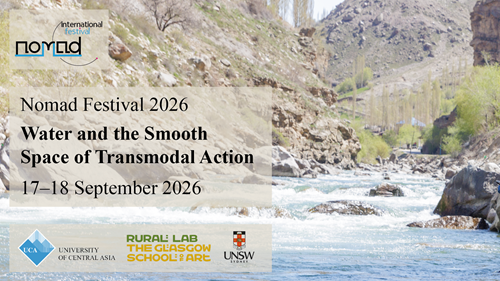
17 September 2026 - 18 September 2026
Experience gives knowledge substance; knowledge gives experience form; action gives both meaning.

Four Rivers (l-r) Findhorn River, Scotland, Alan Hodgson 2012; Gunt River, Khorog, Tajikistan, "Chorog.JPG", Alexander Flühmann, via Wikimedia Commons, licensed under CC BY-SA 3.0; Naryn River, Naryn, Kyrgyzstan, Michael Garbutt 2022; Cooks River, Hurlstone Park, NSW, Australia Michael Garbutt 2023
Thursday September 17: Shannon Scrofano, California Institute of the Arts;
Friday September 18: Bronwyn Charteris-Bailey, UNSW Art & Design
The fifth edition of the Nomad Festival – the University of Central Asia’s annual platform for knowledge exchange, debate, and creative practice – partners with the UNSW Sydney and Glasgow School of Art’s Rural Lab in Forres, Scotland. In this shared space of inquiry and action, we explore the theme of water with a focus on rivers.
Water is the smooth space par excellence, at the heart of deepening global crises. Rivers make the issue tangible: connecting and dividing, bringing life—and sometimes death—carrying the histories and futures of the communities that live alongside them. Over two days artist, scientists, and local residents will meet to share knowledge and experience across three continents, and, most importantly, to act together—and to learn how to act together to support the health of the rivers and their human and more-than-human communities.
The symposium envisions collaborative action through “transmodality”, an approach that unites knowledge, experience, and action. On the first day, our transdisciplinary panels present their research and practice. On the second day, each node runs an experiential workshop to explore sensory engagement with their rivers. In the final afternoon/evening session, we’ll develop plans of action to promote our riverine research, teaching, policymaking, and community work.
In person at UNSW Art & Design Lecture Theatre EG02 and online
| AEST | Session / Speaker |
|---|---|
| 5:45pm–6:00pm | Introductions: from source to mouth Michael Garbutt, UNSW School of Art & Design |
| 6:00pm–6:15pm | Keynote: To think like a river Shannon Scrofano, California Institute of the Arts |
| PANEL 1: University of Central Asia, Kyrgyzstan and Tajikistan | |
| 6:15pm–6:25pm | The smooth space of transmodal action: a new approach to knowledge, experience and impact — Dr Soheil Ashrafi, Dean, University of Central Asia (UCA) |
| 6:25pm–6:35pm | Central Asia's water towers: ice, snow, rain and the future of the Amu Darya and Syr Darya basins — Dr Arnaud Caiserman, Senior Research Fellow at the Mountain Societies Research Institute, UCA |
| 6:35pm–6:45pm | The social life of a river: translating interdisciplinary research into an exhibition — Dr Aibek Samakov, Associate Director of Cultural Heritage and Humanities Unit, UCA |
| 6:45pm–7:00pm | Panel Discussion |
| 7:00pm–7:15pm | Interval |
| PANEL 2: UNSW School of Art & Design, EG02 and online | |
| 7:15pm–7:25pm | From urban drains to blue-green corridors and beyond: narrative shifts in valuing urban rivers — Andrew Thomas, executive officer Cooks River Alliance |
| 7:25pm–7:35pm | From streets to rivers: tackling stormwater pollution with nature-based solutions — Kefeng Zhang, UNSW School of Engineering, UNSW Water Institute |
| 7:35pm–7:45pm | Seeing hidden water: locating the lost wetlands of the Cooks River — Holly O’Neil, University of Technology, Sydney |
| 7:45pm–8:00pm | Panel Discussion |
| 8:00pm–8:10pm | Interval |
| PANEL 3: Glasgow School of Art, Rural Lab, Forres, Scotland | |
| 8:10pm–8:20pm | One river, two tales: the story of Qiqi, the last Baiji dolphin — Xinyue Liu, Glasgow School of Art, Rural Lab |
| 8:20pm–8:30pm | Counter-currents: water in Indigenous literatures of the Americas — Charles Pigott, University of Strathclyde |
| 8:30pm–8:40pm | Fishing (in) the past to inform the future — David Wilson, University of Strathclyde |
| 8:40pm–8:55pm | Panel Discussion |
| 8:55pm–9:00pm | Concluding Remarks |
| Time Zone | Session Details |
|---|---|
| 9:45am–12:30pm Sydney time |
Experiencing the Cooks River In-person only workshop on the banks of the Cooks River at Tempe. Clare Britton (UNSW School of Arts and Media); Michael Garbutt, Kristy Gordon, Richu Jose (UNSW Art & Design) Book via Humanitix → |
| 9:45am–12:30pm Naryn time |
At the Water’s Edge: Liminality, Memory and Place In-person only workshop on the banks of the Naryn River. Lucy Palmer, Senior Lecturer, Communications and Media, UCA An embodied encounter with the Naryn River, using walking, observation and creative writing to explore water as a liminal and relational space. Through attentive engagement with the river and its surroundings, participants will consider how relationships between people, water, landscape, memory and culture shape our experience and understanding of place. |
| 1:30pm–2:00pm Naryn time |
ACTION SESSION Webinar Citizen science on the Cooks River
Mark Secombe, StreamWatch Keynote: Urgent questions at the intersection of contemporary art, ecology and technology
Join Zoom Webinar →Bronwyn Charteris-Bailey, UNSW Art & Design |
| 2:00pm–3:30pm Naryn time |
Collective Action: How are we going to act? |
| 7:30pm–7:45pm Sydney time |
The river restores us Concluding contemplative activity: we’re all part of the same river. |
The smooth space of transmodal action
Soheil Ashrafi
The talk sets out the transmodal landscape for the symposium. I learn by analysis, taking apart water to unearth its chemical and physical properties — understanding how it is constructed, and why it possesses a complex being that withdraws from a full appearance, closed off from my all too distracted perception. I also hold water, smell it, touch it, learning its texture through my unaided sensibility. Now it is the in-between that matters: I perceive it not in isolation, but as part of a whole of which I am myself a part. Past and future collapse into the present, into "the moment of water" before me. Scientific knowledge remains present, feeding into this perceptual meeting — while my perceptual beckoning, in turn, contextualises that knowledge. Materiality enters the scene, tethering itself to the web of morality with my palpation. In both ways of knowing, I am already acting: adapting bodily, stirring feelings, summoning memory — shaping how I move through the world and the craft I practise, water always somewhere within it. No knowledge without experience, no experience without knowledge, neither without practice: the smooth space of transmodal being, the viscosity of thought — and water — in action.
Central Asia's water towers: ice, snow, rain and the future of the Amu Darya and Syr Darya basins
Arnaud Caiserman
This presentation offers an overview of ongoing research conducted by the University of Central Asia and its partners on water resources in the Amu Darya and Syr Darya basins. Downstream, water in these basins is used intensively by the agricultural sector for highly water-demanding crops such as rice and cotton, and is extensively stored by the energy sector for hydroelectric power production through some of the highest dams in the world. Recent years of alarming temperature increases raise serious concerns about current water-use practices and are fueling new debates on how key economic sectors can adapt to climate change. To understand ongoing trends and shifting paradigms in downstream water use, it is essential to look upstream to the cryosphere - the water towers of Central Asia - composed of ice, snow, and permafrost. Studies of the cryosphere's current dynamics offer valuable insight into future water flow trends, making it possible to anticipate potential future changes and strengthen the resilience of mountain communities. Key indicators include the timing shift of peak snowmelt, the transition from rain to snow, the frequency of mountain hazards, permafrost thaw, or the long-term diminishing role of ice melt in river discharge. This session will showcase recent findings on water-use projections, expedition results, modeling, and mapping, adopting an interdisciplinary, upstream-to-downstream approach.
The social life of a river: environmental histories, social worlds and conflict resolution along the Naryn-Syr Darya
Aibek Samakov
A five-year project led by Dr. Jeanne Feaux de la Croix, Dr. Mohira Suyarkulova, Dr. Adham Ashirov, Dr. Gulzat Baialieva, and Dr. Aibek Samakov brought together anthropologists, political scientists, and historians from across Central Asia to explore the social and environmental histories of the region's longest river system. The Naryn-Syr Darya is also the second-largest feeder of the now divided Aral Sea, and its waters have been a major source of tension between upstream and downstream states due to competing interests in hydropower and irrigation. This presentation examines how the interdisciplinary research group collaborated with Central Asian artists to translate complex research findings into an accessible exhibition.
From urban drains to blue-green corridors and beyond: narrative shifts in valuing urban rivers
Andrew Thomas
Across the world, urban rivers have been transformed by development, pollution, channelisation and altered hydrology. Sydney's Cooks River exemplifies this trajectory. Once a significant cultural and ecological resource for Australia’s first peoples, the river was progressively modified through colonisation, industrialisation and urban expansion, becoming one of Australia's most degraded urban waterways by the late twentieth century. Yet the Cooks River also demonstrates the capacity of urban rivers to recover. Beginning with community-led restoration initiatives in the 1980s and 1990s, and later supported through cross-jurisdictional collaboration, the river has become a focal point for ecological restoration, community stewardship and blue-green corridor planning. Using the Cooks River as a case study, this presentation examines the factors that contributed to both degradation and recovery, highlighting lessons for urban river governance, community participation and long-term resilience in highly urbanised catchments.
From streets to rivers: tackling stormwater pollution with nature-based solutions
Kefeng Zhang
Urban stormwater is a major pathway by which sediments, nutrients, metals, litter, microplastics and emerging contaminants reach waterways such as the Cooks River. Yet much of this pollution is generated diffusely across the catchment, making end-of-pipe treatment alone insufficient. This talk will explore how distributed nature-based solutions—including raingardens, bioretention systems and other forms of green infrastructure—can intercept, retain and treat stormwater closer to where it falls. Drawing on research and implementation examples from Sydney, I will discuss what these systems can achieve, where their limitations lie, and how monitoring, smarter operation and better integration with urban planning can improve their performance.
Seeing hidden water: locating the lost wetlands of the Cooks River
Holly O’Neil
Sydney's Cook's River used to be framed by an intricate system of flourishing wetlands. Now, these crucial ecosystems flow through stormwater infrastructure – silenced and invisible. This research explores how creative methods might help to locate and surface these waters stories, to encourage community connection and highlight their importance.
One river, two tales: the story of Qiqi, the last Baiji dolphin
Xinyue Liu
In this presentation, I tell the story of Qiqi, the 'last' Baiji dolphin, who lived in captivity for twenty-two years before his death. The species was subsequently declared functionally extinct. Tracing the history of the Yangtze River, I examine the conflict between development and the conservation of 'ghost species': animals still occasionally sighted but unlikely to survive. I follow efforts to conserve China's two endemic river cetaceans from the 1980s to the present, and show how field observation becomes speculative art, and how dance can turn grief into action. In doing so, I introduce my key concept of conditional apparition, the idea that staging reality, both materially and rhetorically, can allow vanishing and vanished species to persist in cultural memory.
Counter-currents: water in Indigenous literatures of the Americas
Charles Piggott
This paper will present the findings of the “Counter-Currents” project, which compares the role of water in 21st century indigenous literature of North, Central and South America and across eight languages. With a focus on water as both physical substance and symbolic entity, and an important marker of the profound social and ecological transformations affecting the Americas (climate change, pollution, urbanization, cultural shift, etc.), I seek to initiate a new line of enquiry centred on one fundamental question: how are indigenous cultures (i.e., of pre-Columbian origin) adapting their traditional conceptions of human existence to a changing environment? As a laboratory of cultural transformation, literature is the logical place to look for new interpretations of human existence in the modern world, and water, circulating between bodies and geographies, is a key theme in which to find them.
Fishing (in) the past to inform the future
David Wilson
This paper traces the currents and countercurrents of knowledge shaping fisheries management and development programmes—particularly the friction between inherited colonial-scientific frameworks and the situated knowledge of communities. It draws on three international interdisciplinary projects: ‘One Ocean Hub’, ‘Lessons from Lake Malawi’, and ‘Colonial Currents, Contemporary Countercurrents’. Each paired historical analysis with environmental sampling, community engagement, and arts-based practice to investigate fisheries-related challenges across African contexts. At their core, these projects considered how communities relate to the environments they depend on, how that relationship is carried through heritage, and how it might shape more sustainable futures. In other words, questions of custodianship, connectivity, and collaboration — by water.